Recently, I've attended an online course on "Comedy Writing 101" by comedienne Eleanor Morton (and if you don't know Eleanor, check out her YouTube channel; her character "Craig", the utterly bored tourist guide, is especially brilliant if you've been to the places he/she so dead-pan describes).
Now, I don't want to change careers. I can be funny, but only in environments where I feel safe and comfortable. I'm certainly not spontaneously funny, and I didn't expect to improve on any of these fronts through the course. Instead, as you may have guessed, I was interested if there's anything related to presenting.
This isn't a new idea at all. On the recommendation of Garr Reynolds, I've watched the documentary "Comedian" in which a certain Jerry Seinfeld goes back to stand-up comedy and has to (sometimes painfully) learn the traits all over again. And I almost forgot that I wrote a short piece on humour in presentations that didn't make the cut for the Presenting for Geeks ebook. But it's always good to go back to some old ideas and see if there are any new insights.
So, what have I learned?
Inspiration and Brainstorming
 After going through the various types of jokes, Eleanor came to a section that immediately felt familiar: Where to get inspiration? I've written a bit about brainstorming and how to be creative when under pressure before, but this section felt even more relevant to finding and shaping stories for storytelling (in your presentation). One thing that people are struggling with is how to make a story fit. It may be too long or may require a lot of context before the audience can see the relevance to the presentation topic. In my Storytelling course, I show how stories can be compressed and expanded to fit, but I think I'm going to steal this bit of advice for future incarnations of said course:
"Comedians tend to lie about small or normal things rather than big ones."
-- Eleanor Morton
By which she means that the stories that comedians tell are usually based on something that really happened. They tweak only a few details to make it funnier. And I think that's a good approach for stories that you use in presentations, too. Don't make up a story - it has to be true to begin with. But you can tweak the details to make it fit better with the flow of your narrative. You may even have to do some tweaking to protect the anonymity of the persons involved. But, to stress this again, the core story has to be true. You don't want to literally lie to your audience. It's fine to bend things a little in the details.
On Stealing
I already mentioned stealing, and that's something that also came up in Eleanor's course, in the form of a quote from John Cleese:
"If I may give a word of advice to any young writer who, despite the odds, wants to take a shot at being funny, it is this. Steal. Steal an idea that you know is good and try to reproduce it in a setting that you know and understand. It will become sufficiently different from the original because you are writing it, and by basing it on something good, you will learn some of the rules of good writing as you go along."
-- John Cleese
It should be obvious that "steal" in this context doesn't mean literally stealing or copying something. Instead, you take inspiration from it. You know it works (in a comedy setup) or is correct (in a presentation setup), so you take it and rework and repeat it in your own style, thus making it your own. But don't claim you invented it!
Using the word "steal" like this seems to cause misunderstandings all the time. Austin Kleon wrote an entire book about it; it may help clarify the intentions.
Rehearsing
The final similarity is, of course, rehearsing. As a comedian, you have to rehearse your jokes to get the pacing right. The fundamental problem, which Eleanor acknowledged, is that you would need an audience since you're relying on their reactions. You can simulate that, to an extent, with a "friendly audience" of family and friends, but they will, in general, be more forgiving than a real audience.
I'd say as a presenter, you have a slight advantage here. I would still recommend rehearsing in front of a friendly audience, but you have the advantage of being able to research the potential audience of your talk. As a comedian, you will only have a rough idea who will attend the event, and it only takes a few people who hate you and your jokes to make your job a lot harder.
In Summary
The similarities - but also the differences - between the two disciplines of comedy and presenting are obvious. As a presenter, I think it's worth looking at how comedians work to see if you can pick up a tip or two. And who knows, you may even come up with a genuinely funny joke you can use in your next presentation.
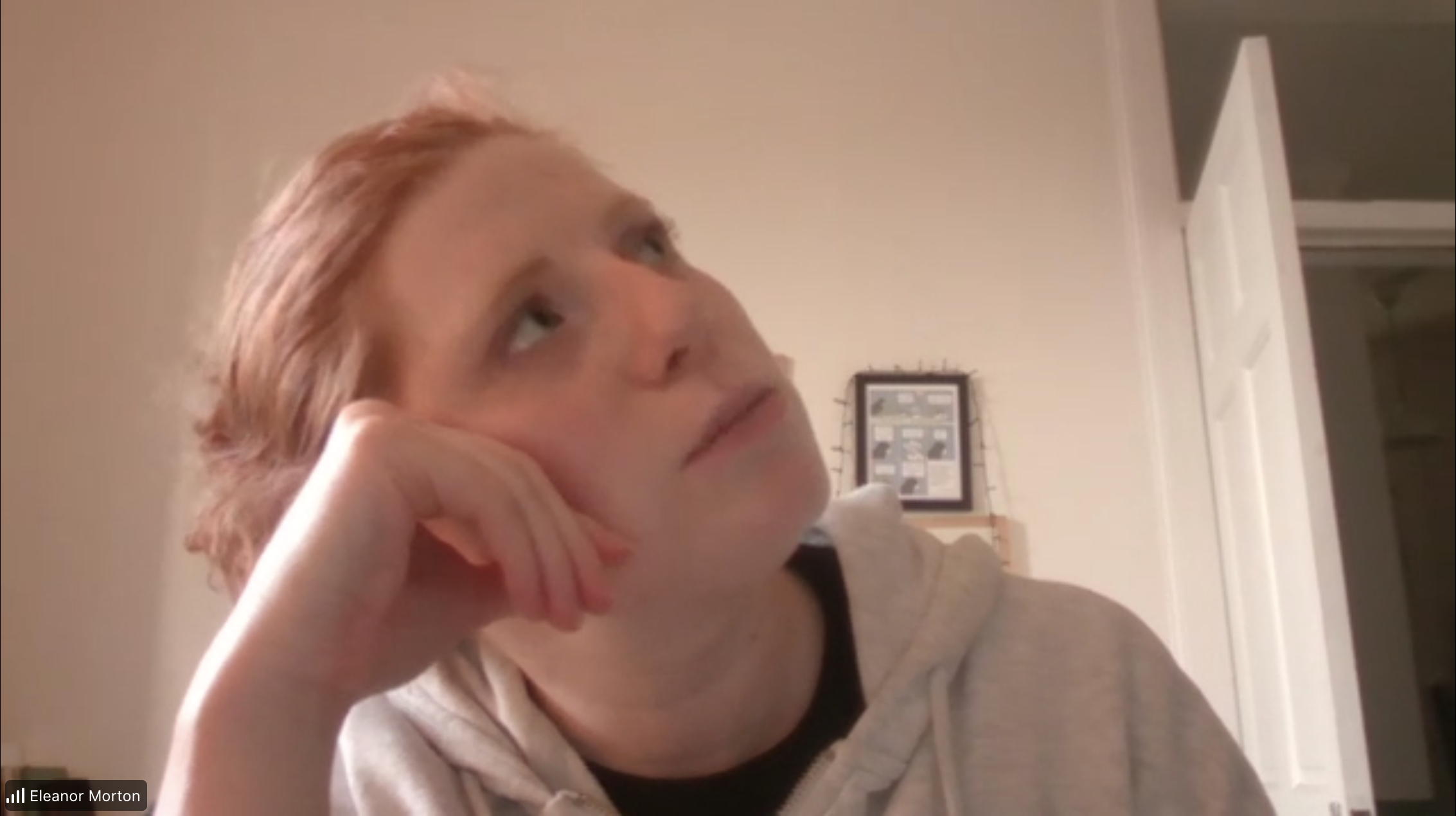
(Photo: Screenshot of Eleanor Morton thinking before answering a question from the audience during the course.)
Please email me for details.
 "On Comedy Writing" by Dirk Haun is licensed under a Creative Commons Attribution-ShareAlike 4.0 International Licence.
![[Cover: Presenting for Geeks]](/images/thestock/p4g-english-new.png)